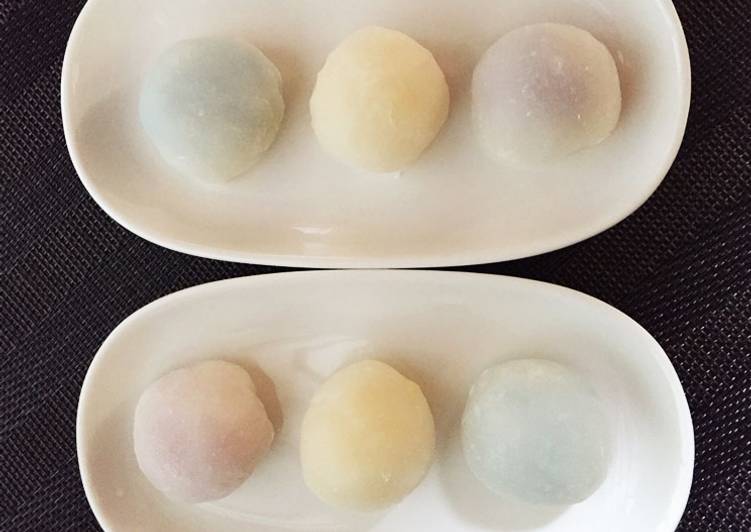
Hey everyone, it is Louise, welcome to my recipe page. Today, I will show you a way to make a special dish, wagashi <mock "daifuku"cooked using microwave >. One of my favorites food recipes. This time, I will make it a bit unique. This will be really delicious.
Wagashi <Mock "Daifuku"cooked using microwave > is one of the most favored of current trending meals in the world. It is appreciated by millions every day. It is easy, it is quick, it tastes delicious. They are nice and they look fantastic. Wagashi <Mock "Daifuku"cooked using microwave > is something which I’ve loved my whole life.
Sweet/Glutinous brown rice mochi daifuku stuffed with dates and black sesame, dusted with kinako. Daifuku (大福) or Daifuku Mochi (大福餅) is a type of wagashi (和菓子), Japanese sweets. You can quickly steam mochi on stovetop or in the microwave.
Guide to Make Wagashi <Mock "Daifuku"cooked using microwave >
To begin with this recipe, we have to prepare a few components. You can cook wagashi <mock "daifuku"cooked using microwave > using 6 ingredients and 8 steps. Here is how you can achieve that.
Ingredients
The ingredients needed to make Wagashi <Mock "Daifuku"cooked using microwave >:
- Get 100 g Shiratama-ko (a kind of rice flour)
- Make ready 50 g Sugar
- Get 150 ml Water
- Get 120 g White Kidney bean jam
- Get Food colorings
- Prepare Potato Starch
Daifuku Mochi is one of the most traditional but very popular Japanese sweets. Mochi is usually made from sweet rice (also called Mochi rice) cooked and pounded until it becomes a paste that is very sticky and smooth. Daifuku, AKA Daifuku Mochi, is a type of Japanese sweet usually served with green tea. It is commonly filled with red bean paste.
Instructions
Instructions to make Wagashi <Mock "Daifuku"cooked using microwave >:
- Ingredients for 12 pieces
- Colorize the white bean jam with food coloring dissolved in water. 30g→blue 30g→purple 30g→yellow 30g→red
- Divide each color bean jam into 3 and make them round.
- Make Mochi with Shiratama-ko (a kind of rice flour). Put the Shiratama-ko into a boul. Pour the little water. Mix them as smashing lumps of shiratama-ko. *Add the water little by little (for 2 or 3 times).
- When it's no longer lumpy, add the rest water and mix them with a spatula. Add the sugar and mix them.
- Pour the mixture in a heat‐resistant container through a sieve. Heat it at 500W for 2 min in a microwave oven. Take it out and mix it. Heat it at 500W for 2 min. again.
- Sprinkle the Potato Starch on a steel tray. Put the Mochi on it. Cut the Mochi into 12 as sprinkling the Potato Starch.
- Wrap the bean jam balls with the Mochi. Brush off the Potato Starch.
The flour is mixed with water and steamed either on the stovetop or in the microwave. With this quick method, sticky tasty mochi is ready in no time. A fun take on everyone's favorite Fun to make and to east, these Japanese sweets are easy to make with a microwave in only a few Great recipe for Plump Matcha Daifuku. The matcha daifuku that I saw in an online store looked. Wagashi are traditional sweets in Japan that has a rich history, story and culture.
As simple as that Simple Way to Make Wagashi <Mock "Daifuku"cooked using microwave >
So that is going to wrap it up with this special food wagashi <mock "daifuku"cooked using microwave > recipe. Thanks so much for reading. I am confident that you will make this at home. There is gonna be more interesting food at home recipes coming up. Don’t forget to bookmark this page on your browser, and share it to your family, colleague and friends. Thanks again for reading. Go on get cooking!
Print this page